What's the Idea?

I’ve been thinking a lot lately about conceptual art. More specifically on how it fits into my art-making process. And I’ve decided that it doesn’t, and that’s ok. Though most of the big shows and art press are all about installations, performances, and the like, I don’t work that way. I work the other way around - let me ‘splain…

All artist’s conceptualize - even Bob Ross did. His happy trees and babbling brooks didn’t appear out of the ether. We humans are thinking machines, even artists. It’s simply a matter of how you conceptualize. Some artists (like me) work out our ideas visually and then ruminate on a body of work to see what that unconscious incubator between the ears has been conceptualizing in the background. Others do the thinking part up front. And I would guess that the execution is already mostly completed in their heads before they pick up a tool. It’s simply a matter of the order of the process.

It took me awhile to figure this out. In art school, one of my best friends was probably the first conceptualist I knew of. Her name was Sharon McCarthy (RIP), and she was a conceptual sculptor. She often spent more time planning and thinking about her work than in the execution. We had many animated discussions about what was more important - the idea or the finished piece. The answer, of course, is both, but I didn’t know that at the age of nineteen.

SharonConcept.jpg

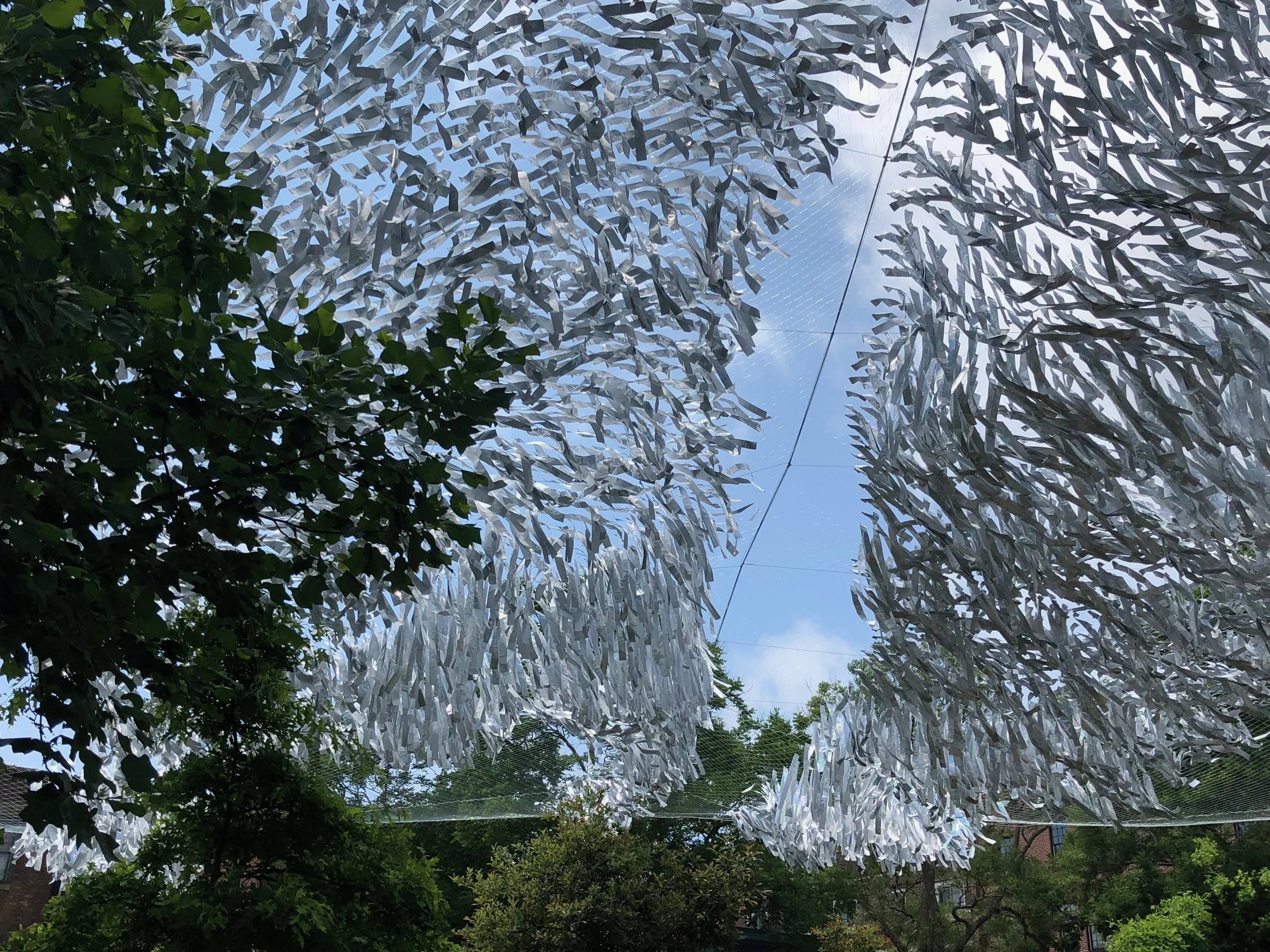
Fast forward forty years and I’ve learned a few things, thank God. Because if I hadn’t, I wouldn’t have the deep appreciation for guys like John Magnan. You can see his new show at The Narrows Center for the Arts in Fall River. It’s entitled “Thor’s Hammer” and it’s well worth the trip if you want to be intellectually stimulated AND visually floored by a body of conceptual art. The entire package needs to be experienced in person, so I won’t synopsize here, but please check it out. It has everything a great piece of conceptual art needs: a unique perspective, clarity and an idea that excites your mind AND eyes.

ConceptJohnM.jpg

THAT’s conceptualism.

Layers

I’ve been thinking a lot about layers recently.

If you visualize our “selves” as a collection of layers, like a tall stack of pancakes, or (if you are of a certain age) a stack of vinyl LPs on the spindle of a turntable, over time we accumulate a lot of layers. Not only in years, but in experiences, professions, partners, belief systems, and so on and on… And in the end, others only see the stack as a whole. The individual layers are often hidden.

I think of that sometimes as I’m slapping on new layers of paint. Some are light and barely noticeable at first. Maybe a soft glaze to take the edge off a horizon, or a more substantial reworking of the overall composition. And then there are the bold slashes of color that catastrophically change the direction of the painting altogether. But, in the end, the viewer is aware of only the finished piece.

IMG_3486.jpg

Morning Shift

One advantage to self-employment is the flexibility to make your own hours. So, after many years of painting in the evening after my day job, I’ve decided to try a new pattern and work in the early morning. In theory, my brain should be sharper and rested and at optimal capacity….if only my body can stretch and keep up! The first day was today and so far, so good. The stillness is invigorating and the air feels new. The light changes quickly with the studio facing northeast, but I don’t often paint from life anymore, so it really doesn’t matter. I even eschewed my coffee until after as a reward. If I can discipline myself to continue this, I have high hopes for where it leads.

IMG_3483.jpg

Summer Studio Prep

Cleaning my studio is not a chore for me. No matter how organized I think I am, in the act of picking up I invariably find a brush I thought I’d lost, a sketch that was “mis-filed” or a half-eaten cruller. It also becomes a time of rediscovery - an old postcard unearthed that you didn’t even know you kept or a library book that was not returned on time (sorry, Ms. Brennan!) At any rate, I really like doing it. To have one’s materials, tools, references and inspirational objects (read: assorted crap) at the ready is a wonderful feeling. And it frees me up for the real work when I walk into the studio.

The approach. The most difficult confrontation is facing a blank canvas. I prefer a full frontal assault.

The approach. The most difficult confrontation is facing a blank canvas. I prefer a full frontal assault.